

|
This fanfiction article, Project BALLISTA, was written by EvenManatee887. Please do not edit this fiction without the writer's permission. |
|
This fanfiction article, Project BALLISTA, is currently under active construction. |
| Project BALLISTA | |
|---|---|
 | |
| Chronological information | |
|
Active |
Yes |
|
Engagements |
|
| Command information | |
|
Affiliation |
|
|
Branch |
|
|
Type |
Heavy Assault Drone Unit |
|
Role |
|
|
Unit size |
|
|
Command Structure |
United Special Warfare Command [SPECWARCOM] -Special Warfare Group SEVEN
|
|
Component units |
|
|
Garrison |
TBD |
| Other information | |
|
Nickname |
Ballistas, Terminators, Bots |
|
Motto |
Nos Ad Infernum, (We are the Hellfire) |
|
Commanders |
Brigadier General Anastasia Greyson |
|
Era |
|
| [Source] | |

Project BALLISTA, officially known as the BALLISTA/HRUNTING Heavy Assault Drone (HAD) Program, is a special weapons project pioneered by Brigadier General Anastasia Greyson of the UNSC Army. The goal of the project was to create autonomous combat drones which could take the place of human lives on the ravaged frontlines of the Human-Covenant War. While the project itself was reliant on nearly century-old technology at the outset, years of development under Army Special Weapons would see the final drones become far more than their lineage would suggest.
Despite their late introduction, the BALLISTA HADs, often called Ballistas, proved to be remarkably capable. While the project lacked the funds to create enough Ballistas to replace soldiers on the frontline, they had found another role as an asymmetric fire support unit. Ballistas often found themselves operating alongside conventional forces or in support of them via focused application of their impressive firepower. While they were initially limited by their proprietary 'Dumb' A.I, continued combat exposure was an effective, if costly, solution.
While no more Ballistas were produced after the Human-Covenant War, they continued to operate in a limited capacity alongside UNSC Army units tasked with retaking human worlds. They found particular success as test platforms in combat against Promethean forces, where they were fitted with experimental weapons and technology in small-scale deployments. The outbreak of the Created Crisis and the rise of the Banished in the Post-War saw a resurgence in the usefulness of the Ballistas, notably because, with SPDR software enhancements, they could be used as a devastating assault and immovable defence assets, few though they were.
Origins
The New War
The origins of the Ballista Programme began at the outbreak of the Human-Covenant War in 2525. In particular, from the mind of one Lieutenant Colonel Anastasia Greyson who was the head of the 106th Armored Regiment, otherwise known as the Hussars. Greyson had risen to her position at an exceptionally young age, attaining the rank of Major at the age of 26 where she served as Brigade Operations Officer of the 106th. During this time she attended the UNSC Command and Staff college to further her understanding of armored warfare as well as receiving cross-training with units in other branches. It was due to this she was able to refine several tactics commonly seen in armored warfare to be more effective, which in turn spurred her on to learn of newer strategies and tactics going forward.
It was thanks to her aforementioned training and seeming inherent skill that she gained a promotion to the rank of Lieutenant Colonel, her unit seeing exceptional success in combating Insurrectionist forces on the colony of Rayth III. Over the course of the deployment, Greyson took no restraint in showcasing her ability to lead and push for the use of newer tactics with her forces, which saw them accomplish several operations with minimal casualties. However, it was on November 19th, 2525 where the strategy and nature of war for Colonel Greyson and those under her command would shift permanently.
The 106th Armored Regiment had been stationed to the colony of Harcon and like the rest of the UNSC had been placed on maximum alert since November 1st. The first alarms came on the dawn of the 19th November with sensor stations across the system going dark, pushing the military garrison of the Harcon into partial alert which turned into full mobilization as the defending naval force was engaged by the Fleet of Thunderous Hymns. The ground invasion came mere hours later with a mass landing of Covenant forces across the supercontinent leading to engagements across the world.
Lieutenant Colonel Greyson and the 106th were engaged from the start of the invasion, mainly tasked with defending key strategic routes leading towards the supercities near the center of the continent. However, with their overwhelming orbital strength and sheer numerical superiority, the Covenant brushed aside the defenses with relative ease. By November 24th, the vast majority of the planet had fallen to the Covenant with the remains of the UNSC forces now barricading themselves in the city of Rastoff, guarding the final evacuation site of the world. Under orders from Major General Alexander Farchild, Greyson and other officers were evacuated onboard an ONI prowler despite her vehement resistance, leaving the remains of the 106th to fight a desperate but ultimately futile defense of the spaceport.
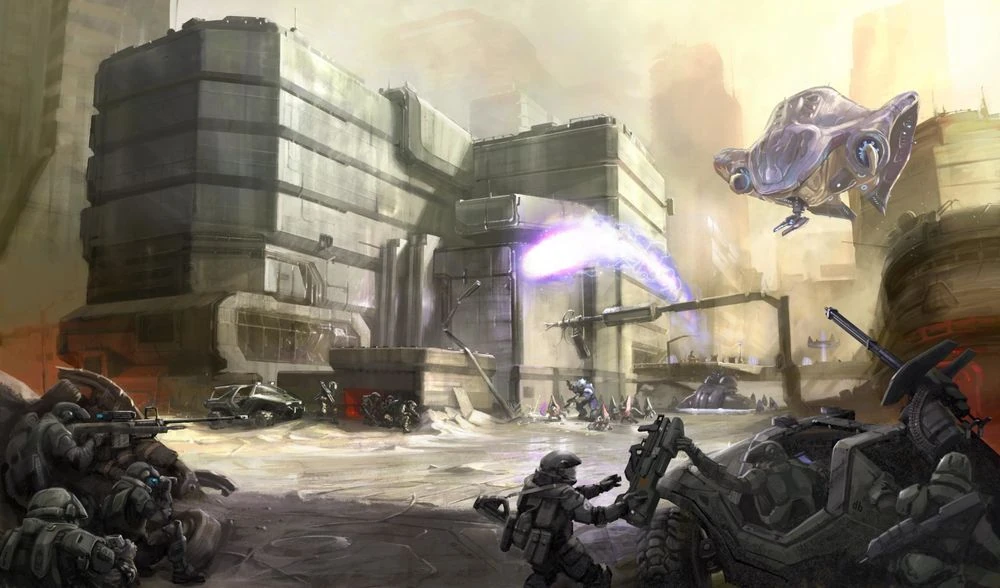

The remnants of the 106th would continue to fight throughout Rastoff, despite knowing they had been left behind.
Greyson and the remains of the 106th were evacuated to the colony of New Carthage for recovery and debriefing. Upon her arrival to Fort Llewellyn, the main UNSC garrison on the planet, Greyson was debriefed by Major General Fairchild as well as two other generals who would reveal that a mere 2 platoons of the 106th had been evacuated along with a fraction of the command staff. Colonel Greyson had reacted with significant hostility both towards Major General Fairchild and the ONI Officer who facilitated her evacuation, as she had felt that she had abandoned her unit to die while she was ushered to safety. This was compounded on the following day where she was awarded with a medal for her bravery and resolute leadership in the light of an overwhelming enemy force. Greyson greatly opposed her reception of the medal, citing the losses on Harcon as a complete and utter failure both as a leader and soldier, however, she was rebutted by the Army Staff who believed that she could serve as a symbol, a hero to inspire people across the colonies to band together against the Covenant. Despite her further objections, she was forced to begrudgingly accept. However, during the subsequent press conference, Greyson had discarded her rank insignia's prior to taking the podium which earned her a sharp reprimand from Fairchild afterwards.
A Change of Doctrine
In light of the losses sustained during the Battle of Harcon, Lieutenant Colonel Greyson personally saw to the rebuilding and reorganization of the 106th. As a result of her new position she would also push for the inclusion of new tactics into the training of the 106th, many of which had previously been dismissed or overlooked in favor of more traditional armored warfare doctrine. One particular tactic was referred to by Greyson as the ‘Barricade’ which saw heavy armor breaking enemy lines and then defending those entry ways to allow following armored and mechanized units to punch deeper while protecting their rear. This very tactic saw employment in January, 2526 when the newly rebuilt 106th Armored Regiment was deployed to the colony of Narrond, a little populated Outer Colony which served as a UNSC seat of power in the region and was projected to be the next target of the ongoing Covenant onslaught.
This prediction would ring true only weeks later on the 21st of January, a Covenant fleet was engaged in a bitter brawl with the defending UNSC fleet around Narrod which in turn saw the mass landing of ground forces to disable what was left of the orbital defense network. As the invasion progressed and the Army was forced back, Greyson and the 106th were charged with the defence of the eastern approach to one of the few operational bases left. As the Covenant force advanced, they were met with a savage artillery barrage which served to stun and slow them, allowing Greyson to push her own advance, much to the surprise of the other defending regiments, right into the Covenant lines. It was through her application of the ‘Barricade’ tactic that Greyson was not only able to halt, but was able to force the Covenant advance into a retreat and eventual encirclement.
Her success during the Battle of Narrond earned Greyson a great deal of respect from her peers in the Armored Corps and even in the wider UNSC Army, despite the planet being lost, as she had show that the UNSC need not simply wait to be attacked but could also push offensives on their terms. However, due to the publicization of her actions, her relationship with Major General Fairchild took a turn for the worse. The two already having had frayed relations following Greyson's press conference, Fairchild was greatly angered by her widely publicized actions on Narrond and her usage of what were deemed outdated tactics, as it called into question if existing armored warfare doctrine was enough to defeat the Covenant. Therefore, following the evacuation from Narrond, Fairchild would begin to form a case to have Greyson relived of her command.
A New Approach
The Battle of Narrond however, was just the start for Greyson.
Development History
Project QUIVER
Project BOLT
In 2531 there was a renewed interest in the idea, namely by one Brigadier General Anastasia Greyson. General Greyson believed that, with some modifications, the idea proposed by the TARDS could become something far more effective than what its original developers had ever thought of. She had seen first hand how effective augmented soldiers could be in combat as she came across files and recordings of the GOLIATH Program which exhibited fantastic capabilities and results but in achieving such results the long term effectiveness of the unit was diminished. This also had the effect of further galvanizing General Greysons resolve that lives need not be wasted for such dangerous endeavors.
The next year was spent both refining the design along with her research and development team and in a constant battle with ONI to obtain select information about the MJOLNIR Armor for the programme. The largest of these clashes came in October 2535 where General Greyson directly spoke to Admiral Parangosky regarding the programme and it's prospective future and the transfer of some new technology found on final production the Mjolnir Mark IV. At the end of a eight hour long 'conversation' the two had reached a compromise in which Parangosky would authorize the transfer of prototypical shielding, armor composition and design, and finally the blueprints for the Micro-Fusion Reactor. In exchange for this General Greyson had agreed to put aside four of the finalized production models and equip them for use by ONI.
The official prototyping and testing phase of the programme began from December 2535. During this time several mock-ups of the redone design were created and the common design cues of all of them were large, armored and heavily armed robots which looked more akin to mechs than anything else. Initial production variants stood at nearly eleven feet tall and weighed over one thousand kilograms. This excessive size and weight did allow a considerable amount of weaponry to be fitted to them but it also made them far more vulnerable due to the still finicky shielding and slow speed.
Subsequent models were only slightly shorter and stood around ten feet tall but thanks to advancements in weapon miniaturization and more effective armor compositions, they were able to mount similar weapon loads to the larger prototypes, however the issue of mobility stuck out as an ever present issue due to the humanoid structure of the robots. While the fusion reactor schematics were derived from the Mark IV did provide an ample amount of power, they struggled when having to power an entire body as opposed to just the armor systems. Consideration was given to a dual reactor set-up but this was deemed far too risky due to the increased risk of a critical kill.
By 2538 however there was serious worries about the programme stalling as the prototype units exhibited questionable combat efficiency and awareness while their monetary cost remained substantial. Therefore in a gamble General Greyson authorized the development of a new type of 'Dumb' A.I which she would come to call 'Bolts' as a play on the programme name. These A.I greatly differed from normal 'Dumb' A.I in their capabilities as they could actually learn overtime both from combat and interaction with others, although there were limits to this which were mostly due to the hardware's capacity to deal with the mass amounts of information.
With the new A.I the prototypes and testing units had a greatly increased combat effectiveness which seemed to grow between each test as the A.I were exposed to combat feeds and tactical maneuvers. By late 2539 the design for the robots had been finalized and production models were soon being produced, however as a result of the changing design over the years and the choice to develop an entirely new form of A.I the programme had overrun its expected cost, with more funds being directed towards the Spartan Programs as they were deemed more effective.
Therefore by March 2540, after 172 examples had been made, four of which were sent to ONI as per the agreement, the production of further models was halted until results were achieved with the existing models.
Operational History
Battle of Erann IV
The Battle of Erann IV broke out in November 2539, UNSC Navy Forces having been locked in a stalemate with Covenant Forces attacking the planet due to the wide array of Orbital Defense Platforms (ODPs). As a result of this stalemate, Covenant forces began to target specific areas within the ODP grid to allow them to land forces groundside and take out the ODP network from below. However, like the UNSC, they had become dragged down by constant attacks from Insurrectionist cells scattered across the supercontinent, this was further accompanied by raids conducted by UNSC Army Rangers as well as air strikes. As a result, a stalemate had arisen over the months since the start of the battle, with both UNSC and Covenant forces hunkering down and conducting numerous covert raids on each others positions. One such raid was to be the very first deployment of the Ballistas in combat.
On May 22nd, 2540, twelve squads of Ballistas, with team leaders Warwolf, Engram, Reinhardt, Helepolis, Cataphract, Scorpio, Corvus, Mangonel, Petard, Gustav, Dora and Tsarina were deployed for Operation PERSEUS. The primary objective for the teams was to advance to and subsequently break through a remote mountain pass which had been fortified by insurrectionists with numerous traps, ambush points and hidden weapon emplacements, on top of these was the narrow pass itself, which limited armored columns into single file, making them particularly vulnerable. In an attempt to show off the superiority of her Ballistas over conventional armored units, General Greyson had all twelve squads march in formation, down the pass and towards the target area. Upon reaching the edge of the designated area, a broadcast was made on all channels for any forces in the area to surrender immediately, in truth, the purpose of this was to allow the deployed Ballistas to conduct multi-spectrum scans of the area to detect whatever traps had been set. With no response to their order, all twelve squads advanced into the the area, immediately coming under fire and returning it tenfold. Emplacements in the rocks were shattered by cannon fire, mines hidden beneath the ground were shot and detonated, creating massive clouds of dust and rubble, blinding the attackers but leaving the Ballistas unperturbed; all throughout the attack, the Ballistas continued to advance, clearing the pass with savage efficiency. Within two hours the pass had been cleared of all targets and traps, at which point the Ballistas were ordered back to base, marching past an advancing UNSC armored column.
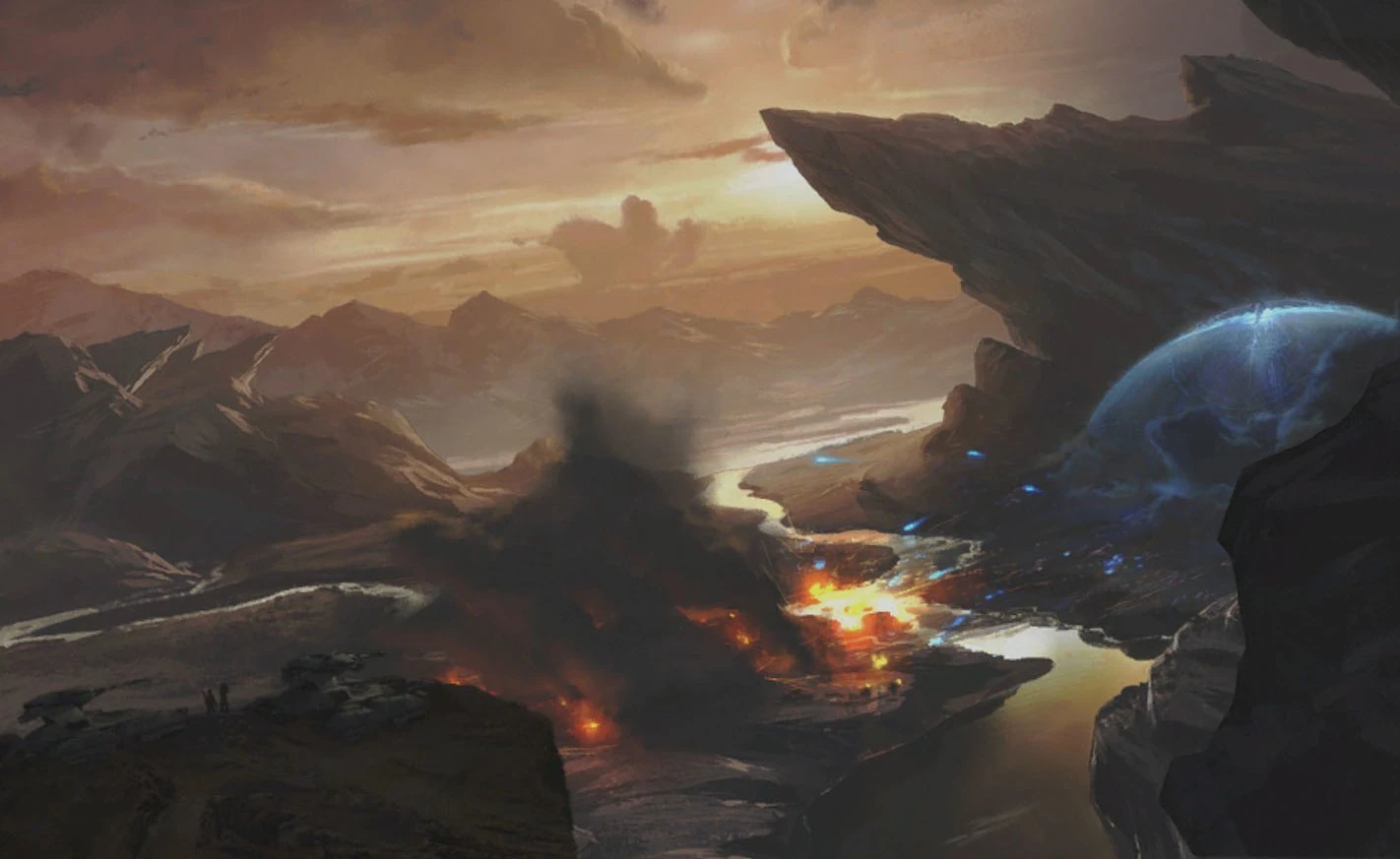

The success of Operation PERSEUS allowed UNSC Army forces to breakthrough a heavily defended Covenant chokepoint.
While this first deployment of the Ballistas had been a resounding success, more than showcasing their lethality, toughness and earning them praise from other leaders in the Army, it did reveal some worrying truths about the Ballistas in combat. Upon review of combat data, the competency of Ballistas in the field had shown to be far below what had been seen during testing scenarios, as was evidenced by some of them showing heavy damage to their armor due to their inability to respond to sudden threats in the field. While it was known that the Ballistas would need sufficient time to become more competant combatants, concern grew within the programme heads of just how much time would be needed.
Atlas Moons Campaign
Operation: DAISY CUTTER
Over the course of the Atlas Moons Campaign, the Covenant had made repeated raids and attacks on various moons in an effort to overextended the defensive lines of the UNSC Forces. One such raid was as the First Battle of Julianus, where a contingent of twelve CCS-class battlecruisers assaulted the moon of Julianus, however, 4 immediately destroyed by a salvo from the unexpected orbital defense platforms. In an effort to salvage the offensive, Shipmaster Ker' Saluthamee ordered his ships to target an individual section of the array with massed fighters and boarding craft, in an effort to break through to the surface. The gamble just managed to pay off, as a trio of stations were destroyed allowing the now 5 battlecruisers to punch through, two more having been destroyed by the arrival of Admiral McLeese' battlegroup.
Upon punching through the orbital array, the Shipmaster ordered his ships to assault the capital city of Julianus, targeting major military infrastructure around the city. In response to the attack, local UNSC Army Divisions and Air Force Wings were rapidly mobilized to repel the invasion force, the main units here were the 77th Mechanized Infantry Division and 8th Armored Division under Lieutenant General Blakemore which comprised the 4th Field Corps; they were further supported by the 105th Air Wing under Wing Commander James Bellmotte. Despite their damaged state, the five cruisers formed a staunch defensive line against UNSC forces, causing heavy causalities against both the military and civilian population around the Capital. As more cruisers arrived over the world, they were engaged by Admiral McLeese's battlegroup, preventing them from furthering the ground assault. With the ground battle grinding to a halt, and both sides struggling to get reinforcements, Major General Greyson and her Ballistas were redeployed to Julianus to undertake Operation DAISY CUTTER.
Operation DAISY CUTTER comprised the Ballistas arm of a combined offensive against the Covenant invasion force with Army, Air Force and Naval forces acting in concert to force the cruisers from the planet. The offensive would begin with a massed air assault from 105th Air Wing to draw the fire of the cruisers and occupy defending fighters while Admiral McLeese' battlegroup would split up, a portion of ships entering the atmosphere to further occupy the cruisers while the Admiral and the rest of his ships would engage the ships in orbit. The final two prongs of the Operation was the Army offensive against the Covenant lines and finally, the Ballistas themselves who, despite Greysons hesitation, were to be deployed alongside paratrooper units to assault the cruisers. As the assault began, five Ballista squads were prepared to deploy from a flight of Pelicans, equipped with a series of parachutes and single use jet packs to allow them to drop. As the signal was given, all five squads mobilized and jumped from their Pelicans, each squad targeting a specific cruiser with paratrooper units accompanying them to blow open an entrance for them to enter the ships.
Each team shared the same set of objective to carry out once them had entered the ships. Splitting into three pairs, each pair would target specific sections of the ship, Pair 1 would assault the 'neck' of the Cruisers and assault the Bridge, Pair 2 would target the midsection of the ship, ahead of the Hangar, to target the reactors and cut off reinforcements from the hangar to the bridge. Finally, Pair 3 would target the engines and meet with Pair 2 in the Hangar and then continuing to clean out the ship of any survivors. The one exception to these objectives was the objective targeting the flagship of the fleet, Pair 1 in this case were ordered to secure the bridge with minimal damage and begin a mass purge of files from the ship, back to command. Most squads were able to clear their ships, but due to the closeness of the combat several sustained heavy damage and had to be carried to the hangar for their exfiltration. But due to the worsening situation outside the ships, their exfiltration craft were cut off and they had to resort to exfiltration B, which was a direct drop from the ships, towards the surface. As all callsigns reported their completion of objectives, all five squads dove once again towards the ground as the cruisers gradually fell from the sky and were perpetually hammered by other UNSC forces until they crashed.
While the overall outcome of DAISY CUTTER had been a success, there had been several notable failures both with the Ballistas and other forces in the assault. Naval forces, over the course of the orbital battle, sustained heavy damage from the defending cruisers with Admiral McLeese falling with his ship just before the final cruiser had been taken down. Despite the heavy damage, two cruisers did manage to break orbit under emergency power only to be cleaned up by the remainder of Admiral McLeese's battlegroup. Both the 4th Field Corps and the 105th Air Wing has also sustained heavy casualties as friendly ships fell, resulting in far more fire being directed towards them and cutting off the primary exfiltration craft of the Ballistas from recovering them. While all the Ballistas had sustained varying levels of damage, four had required complete limb and weapon replacements as the overwhelming fire in some of the ships had proved too much, even for their heavy armor. One advantage of this was that during testing for the repaired bots, the A.I showed exceptionally improved combat ability in confined areas, using one of their arms to move themselves around faster while they engaged with the other. Further damage was sustained in almost all models during their exfiltration from the ships as the single use jet packs proved near useless in slowing them down enough prior to impact, resulting in partial warping of leg joints and their subsequent replacement.
Despite these failures, Operation DAISY CUTTER was widely seen as a success by leaders in the UNSC as it succeeded in forcing the Covenant from the world as well as destroying several of their ships. The Operation would become a landmark in the legacy of the Ballistas as it was one of their earliest and most impressive victories and would see the participating units gain quite the reputation over the course of the Atlas Moons Campaign, despite their more public failures elsewhere.
Siege of New Lancaster
Operation CONQUEROR
Over the year since the start of Siege of New Lancaster had begun, the Covenant had turned the continent of Falk into their main staging ground and beachhead to assault the remaining UNSC forces on the continents of Darbin and Belfast. As of May 12th 2542, the Covenant had pushed back UNSC and UEG forces defending the coastline of Darbin and had begun to establish a beachhead from which to advance further inland. While most UNSC forces in the region consolidated their defenses for the oncoming assault, there was serious consideration by leaders in the UNSC Army and Air Force to launch a preemptive strike against the Covenant beachhead and push them back. To that end, Operation CONQUEROR was organized by Brigadier General Greyson both to aid the planned assault and regain the Ballistas their reputation which by now had been sufficiently hurt.
On the night of May 15th, 4 squads of Ballistas under the control of units Engram, Helepolis, Warwolf and Cataphract were inserted 20 miles north of what satellite imagery had revealed to be the main Covenant staging ground on the continent. All 4 squads began the march to the mountains overlooking the staging ground shortly after midnight and continued to trek through the night, passing through Phase-line Alpha at Huntrenon Forest, at which point two Armored Divisions, the 2nd and 64th, under Brigadier Generals Jackson Westoff and Olivia Kloz respectively, began to make their way towards the staging grounds from the south-east, across the Erra Plains. Back on the mountains, the Ballistas had come upon several unexpected guard posts, seemingly cloaked to have escaped orbital recon. The four squads broke formation and organized themselves into eight separate spearheads of three, each targeting a guard post, when the opportunity presented itself, all eight moved with clockwork precision to assault the guard positions, targeting comms devices and sensor equipment before turning to eliminate the meager troops defending.
With the Ballistas having reached Phase-line Bravo at the peak of the mountains, only a few hundred meters from their positions, the Air Force mobilized, deploying a squadron of C709 Longsword bombers along with three Squadrons of C712 Longsword strike fighters to aid the ground offensive. As dawn broke on the 16th of May, the offensive was in full swing, the armored divisions were now only 10 miles from their position and the bomber squadron was preparing to strike at the now mobilizing Covenant aircraft. Having reached their objective, behind and above the Covenant frontlines, the Ballistas began to conduct in-depth analysis of the assembled forces, preparing firing solutions and engagement profiles to deal the most damage. Having confirmed their positions, all team leaders were given authorization to engage at will. This started with all 24 Ballistas unleashing a barrage of 90mm cannon fire, specifically targeting anti-air positions, hostile armor and dug in forces deemed sufficiently dangerous. The attack had caught the Covenant completely off-guard both due to its point of origin and the surprising lethality of the strike, as a portion of the armor and fortifications had been destroyed, the infantry made to respond but were barely able to as a result of the following barrage of heavy machinegun fire from the Ballistas as they closed in on the frontlines. In the process of this, three Ballistas suffered heavy damage and were forced to take cover to continue the fight while the others formed a perimeter to continue the attack despite the increasing chances of getting overwhelmed.
However, as the Covenant lines fractured and shifted to engage the Ballistas, the 22nd Bomber Squadron along with the 31st, 84th and 12th Strike Squadrons began their assault, the 22nd targeting the veritable hive of Covenant aircraft with heavy bombs, destroying dozens as they were taking off, while the 31st, 84th and 12th conducted wide scale missile strikes and gun runs, both relieving pressure on the Ballistas, one of which had been disabled but still technically alive, and opening the path for the 2nd and 64th Armored Divisions to break through the Covenant lines.
The success of Operation CONQUEROR proved to be a major turning point in the ground battle on New Lancaster as the Covenant had lost numerous high ranking ground commanders and resources. Not only that, but it also allowed the UNSC to re-establish defensive positions across the continent and provided a massive morale boost. Though none seemed to be as happy about the success of the Operation as the leaders of Ballista, their part in CONQUEROR and the effectiveness of the Ballistas in combat had rebuilt and solidified their reputation and their usefulness as an investment. The latter being particularly important as several were damaged and two were nearly destroyed in the process of CONQUEROR.
Battle of Rodion
Battle of Actium
Operation BREAKPOINT
Generation 1 (GEN 1) Ballista
The Generation 1 Ballista's were the first series of the Hyper Mobile Weapon Platforms (HMWP) known as the Ballistas. The GEN 1 production does not however solely include the serial production models, it also includes initial prototypes, testing models and pre-production test beds of various design and complexity. While the number and differences of each iteration are obvious, the commonality between them was actually lower than suspected the most significant being the design of them as large, armored robots.
Mark I
The Mark I of Generation I was the first of the prototypes to test the concept put forward by General Greyson, only two examples were made and both differ wildly from the subsequent prototypes. The most noticeable part of the Mark I was its size and its greater similarity to a mech rather than a robot, with it being a quadruped walker and having a vaguely chest shaped 'torso'. Given its size and as a test of concept it, it was armed with a GAU-23 autocannon on its left arm, a 5-cell Argent-V missile pod on its right arm and a KG Mark 34 Incendiary Mortar. Standing at 17.3 feet tall and weighing 8 tons at a combat load and 10 tons at full load, it was far larger and heavier than subsequent prototypes. Despite this, its armaments, relative to its size, were very impressive but the size of them proved completely unacceptable to Greyson and her team therefore both were dismantled.
Mark II
Mark II of Generation I was the first of the prototypes to follow the new design parameters laid out by General Greyson and were a massive change from the concept test that was the Mark I. The most striking change was in the very frame of robot, which had been changed from a quadruped walker layout to a more traditional bipedal layout with two legs and two arms attached to the torso with a head being absent to provide more space for weapons. Given it sought to refine the serious issues of the Mark I, the Mark II was decidedly smaller as it stood at only 15 feet tall and weighed 8 tons. However in the pursuit of mobility and size the design team was faced with the choice to either reduce the armor or reduce the payload of the Mark II. The decision was made to make four prototypes, all of which balanced armor and weapons in varying capacities ranging from a mere 40mm of armor to 90mm and weapon payloads ranging from M41 Vulcans with APHE rounds paired with back mounted M340 40mm autocannons to GAU-23 autocannons paired with upscaled versions of the M68 gauss cannon.


A 3D model of the MK2 Ballista frame, before the addition of its main weapons and armor.
Throughout the testing phases of these prototypes a number of issues would come to light such as the thinly armored but heavily armed prototype having mounting brackets and joints warped or damaged by the constant recoil of the heavy guns and the gauss cannon causing systems to short circuit. While the heavily armored one became too sluggish to use its already relatively weak weapons effectively. However, of the four prototypes, two stood out. These were two who both were not the best armored or fastest of the four, but rather they balanced both aspects exceptionally, one having slightly more armor and being slower and the other being faster but slightly lacking armor and weapons.
These two would go on through several testing phases to gather data which would eventually be used to develop the Mark III, these two would be maintained as tech demonstrators for the Mark III but would eventually be dismantled as future models became smaller, lighter and more capable.
Mark III
The initial models of the Mark III Ballista were the two best performings of the Mark II prototypes. These were further equipped with new components such as a smaller fusion reactor, Titanium-A2 armor, improved software, and hardware to allow for a broader set of combat subroutines to be programmed. The sharp increase in performance resulting from these updates was noticeable as the bots were faster, could take more damage, and exhibited improved combat performance. However, given that these were still technically Mark II bots, General Greyson theorized that new-build Mark III's could still be smaller overall and gave the green light for their construction.
Frame
Mark III Ballistas differed heavily in the design of their frame compared to the Mark I and Mark II, partly due to increased interaction from General Greyson. As opposed to the lumbering quadruped form of the Mark I and the digitigrade legs of the Mark II, the Mark III featured a completely new frame that was far more humanoid, featuring two arms, two plantigrade legs, and a head. The primary advantage being that the use of this form of legs decreased the amount of space taken up which allowed the Mark III to operate in more confined areas. Similarly, the use of two arms allowed for a wider range of articulation and, through the presence of actual hands and fingers, allowed the Mark III to lift objects or obstacles and aid itself in navigating rough terrain. Further advantages of the humanoid frame were the vastly simplified maintenance through the relocation of the fusion reactor into an armored capsule deep within the upper abdomen and lower chest of the bot. Further ease of maintenance arose from the usage of arms instead of excessively wide torsos as in the Mark I and Mark II, as the arms could just be removed to access the internal systems.
Further changes, as seen in the testing models of the Mark II, were the replacement of the Titanium-A battleplate structure with the newer, stronger, and lighter Titanium-A2 structure on top of which was mounted the new composite armor array. This iteration was an improvement over the previous ones as it provided a 20% increase in performance over the Mark II's composite through the use of new heat resistant ceramics, the aforementioned A2 armor, and a new hydrostatic gel layer which regulated the internal temperature of the internal systems and kept them cool. Another improvement, as a result of lessons learned with the Mark II, was the installment of high strength joints, supported by hydraulic pistons and high power motors which together allowed the arms and legs to sustain far greater weights while retaining mobility and exceptional reaction times. These enabled the Mark II to mount larger and heavier weapons on the comparatively smaller frame without the worry of the recoil damaging the body after extended usage.
The final and most noticeable improvement was the centralization of the sensors and scanners into a 'head' which had since been absent on previous versions as they were considered a vulnerability. However, thanks to the compact frame and improved protection, it was deemed feasible to install a centralized head unit which, in turn, allowed the Mark III to have substantially improved information gathering and targeting info as the head can articulate without moving the body.
Weapons
Mark III Ballistas differed from previous iterations as the experience gathered with the Mark II allowed it to have a standardized loadout rather than several prototypes with various loadouts. The primary weapons to engage ground and air targets are two arm-mounted M291 'Maul' 20mm autocannons derived from the M638 20mm autocannon found on the Falcon. The autocannons use Armor-Piercing High-Explosive (APHE) alongside High-Velocity Armor-Piercing (HVAP) rounds fed via a dual-feed system with 600 rounds in an armored compartment in the mid-back of the Ballista. The rounds have proven sufficient to take down nearly all types of Covenant infantry with only one to two shots except for Hunters whose thick armor needs continuous fire to breach. The rounds also proved capable of dealing considerable damage to light vehicles such as Ghosts, Revenants, and Banshees, however heavier vehicles such as Wraiths require larger weapons to destroy them.
When engaging heavier targets or targets at longer ranges, the Mark III would resort to its two M477 'Tornado' 70mm autocannons mounted on a pair of gyroscopically-stabilized arms behind the right and left shoulder of Ballista and supported by hydraulic jacks to aid in controlling the recoil. The guns share design elements and ammo with the M370 70mm autocannon found on Pelicans but differ in that they feature a longer barrel, muzzle brake, and an armored barrel shroud. The main types of ammo are APHE, HVAP, and Armor-Piercing Fin-Stabilized Discarding Sabot (APFSDS) rounds, the latter offering substantial armor penetration by use of a tungsten penetrator and whose high velocity allows for easy long-range targeting. The M477 is capable of engaging and neutralizing the vast majority of Covenant infantry and vehicles, even larger vehicles like Phantoms and Spirits can be penetrated by the APFSDS rounds which allowed for the carried troops to be torn apart before the ship lands. The M477s are fed from an armored capsule within the upper back of the Ballista which contains 150 rounds.
The final and most destructive of the Mark IIIs weapons is the LAU-6 'Meteor' MLRS, a 6-cell missile launcher mounted in a retractable launcher kept inside the back of the Ballista. It is rated to fire 102mm Semi Armor Piercing-High Explosive (SAP-HE) warheads derived from those used in the M41 SPNKR Rocket Launcher, the main difference being the use of improved thrust vectoring nozzles and tracking systems in the missile. The missiles are more than capable of dealing heavy damage to all known forms of Covenant ground and air vehicles, some of which can be destroyed with a single hit. The launcher features a single reload which is done once it has recessed into the body.
All ammo stores are separate from one another and have separated layers of hydrostatic gel, to reduce the risk of ammo detonating due to excessive heat from extended plasma weapon damage.
Software
Performance
Six Mark III Ballistas weighing in at 7.1 tons and standing at 13.2ft took the field at the Breakpoint Special Warfare Academy on Actium in October 2534 where they would start their six-month testing period. Initial testing saw the Mark IIIs participating in both simulated and live fire, conventional warfare in open fields against mock targets and holograms. The Mark IIIs performed well in these tests as their M291 'Maul' autocannons allowed them to cut down enemy infantry well beyond their ability to respond while at the same time retaining favorable ammo economy as a result of their high accuracy. However, the combat advisors pointed out that during the close-range combat the Mark III showed a lack of adjustment to new targets, often remaining in the same place even as new units such as air targets began to attack them.
The subsequent adverse terrain tests saw the Mark IIIs relocated to the nearby mountain ranges and surrounding jungle. Similar to their conventional warfare training, the adverse terrain tests were composed of live fire training with drones, holographic targets, static and moving targets. Despite the vastly superior frame and more compact stature of the Mark III it still faced issues in the intense cold of the mountains and the muddy swamps interspersed in the jungle. The most significant hurdle was the breaches in the sealant layer covering the joints in the middle of combat. This resulted in joints getting jammed and internal systems getting damaged. Despite these misgivings, the centralization of the sensors into the head of the Mark III did see a marked increase in situational awareness and response times, with it being able to use multi-spectrum view modes to find and eliminate targets before they could pounce.
The final phase of testing was the Asymmetrical Warfare testing in the mock combat town of the Academy, nicknamed the 'Innie Inn', and much like the previous tests, there would be live fire, drones, holograms, and simulations. However, unlike the previous tests, the Ballistas were armed with Tactical Training Rounds or TTRs instead of live ammo, as the combat advisors and some UNSC Army Rangers were selected to simulate a guerrilla warfare scenario. The results in these tests were decidedly below expectations for the R&D Team, combat advisors, and even General Greyson. The size of the Mark IIIs and the long barrels of their M477 autocannons greatly limited their mobility and area of operations as they could not move quickly or in a combat-ready stature in confined halls and even struggled to enter some buildings. Moreso than the M477 was the issue of the LAU-6, as the only explosive weapon provided to the Mark III, it proved to be situational in use during simulated scenarios of protecting evacuating units as the shrapnel may not have harmed the Ballista, but it did sufficiently harm others in the vicinity.


Despite the vast changes and improvements over the Mark II, the Mark III Ballista would proceed to fall below the expectations of the programme heads
As a result of these factors, all six models scored well below the estimated level, much to the surprise and disappointment of Greyson and her team, but under insistence from Dr. Khan and his colleagues they rallied and pushed forward with rectifying the flaws of the Mark III, in the Mark IV. In particular, it saw General Greyson furthering her push for funding, resulting in more frequent clashes with ONI due to their continued growth in funding shares. While Greyson pushed for funding, she also appointed Dr. Rene Lauder as head of programming and A.I development, tasking her to work with the combat advisors to develop more versatile and responsive combat sub-routines.
Mark IV
Improvements
Innovations
Performance
Mark V
Improvements
Innovations
Performance
Mark VI
Improvements
Innovations
Performance
Mark VII
Improvements
Innovations
Performance
Generation 2 (GEN 2) Ballista
Project BOLT
Programming and Training
Roster
Organization
Notes
-The Image used for the Mark II Ballista is sourced from David Fesl on ArtStation
-The Image used for the Mark III Ballista is sourced from Avitus12 on DeviantArt